J.P. Morgan Personal Investing is a UK digital discretionary investment service for people who would rather use a managed portfolio than make every investment decision themselves. It was previously known as Nutmeg. This review is general information, not personal financial, tax or legal advice; investing involves risk and capital is at risk.
Verdict
J.P. Morgan Personal Investing is worth shortlisting if you want a professionally managed, long-term portfolio and value being able to choose from several investment styles rather than building and rebalancing a portfolio yourself. Its published terms say there is no minimum investment period, withdrawals are not charged, and management fees are tiered by portfolio value and investment style.
The important qualification is cost and control. The management fee is only one part of the overall cost: fund charges, transaction costs and market spreads can also affect the investment. The service is designed for long-term investors and the provider suggests considering a timeframe of at least three years. Account rules can also limit when money may be withdrawn, particularly for Junior ISAs, Lifetime ISAs and pensions.
For a UK resident seeking outsourced portfolio management, that combination may be sensible to assess. Investors who want to select their own holdings, minimise management involvement, or need to compare account-specific access rules should review alternatives and current provider documents before deciding.
J.P. Morgan Personal Investing at a Glance
 J.P. Morgan Personal Investing offers discretionary portfolio management: the provider manages a portfolio for the client rather than leaving every investment and rebalancing decision to them. Its published fee schedule lists six investment-style routes: Fully Managed, Socially Responsible Investing, Thematic Investing, Income Investing, Smart Alpha and Fixed Allocation.
The service presents itself as an option for long-term investing. Its FAQ says there is no minimum investment period and that clients may withdraw when they like, subject to the rules of the particular account. It also says the suggested timeframe to consider is three years. That does not remove market risk or make a three-year holding period appropriate for every person; it is the provider’s stated orientation.
The available account range includes a stocks and shares ISA, while the FAQ also covers pensions, Lifetime ISAs and Junior ISAs. Those wrappers matter because access, withdrawals and tax allowances can differ. For example, the provider says that withdrawing from an ISA does not restore the part of the annual allowance already used.
The practical question is therefore not simply whether the brand offers investing. It is whether managed portfolios, its investment-style choice and the relevant account wrapper match the level of involvement, access and risk a reader is comfortable with.
Fees and Charges
J.P. Morgan Personal Investing says it charges an annual management fee for discretionary management, calculated and accrued daily and deducted from the portfolio monthly. The fee depends on both investment style and the value invested.
For its Managed Investment Styles—Fully Managed, Socially Responsible Investing, Thematic Investing, Income Investing and Smart Alpha—the published schedule shows 0.75% a year including VAT on the first value tier and 0.35% including VAT on the higher tier. Amounts held across those managed styles are combined for that calculation. For Fixed Allocation, the schedule shows 0.45% including VAT on the first tier and 0.25% including VAT on the higher tier; it is priced separately because it uses a different structure.
Do not treat those percentages as the complete cost. The provider identifies three separate charges on an account: its management fee, investment fund charges, and market spread. It also says that set-up and transaction charges for buying and selling stocks or bonds are paid from investments and reflected in portfolio performance. Fund and market-spread costs are likewise reflected in the investments.
The provider says clients can see a breakdown of fees and charges in their dashboard, and that management fees are taken automatically on the first working day of each month. Before opening an account, check the current schedule, the applicable value thresholds and the costs associated with the style and portfolio you are considering.
Strengths
A clear appeal is the managed-service format. Readers who do not want to monitor and rebalance a portfolio themselves can assess a service where discretionary management is part of the proposition. The provider’s FAQ acknowledges that a person could replicate portfolios independently, while noting that doing so can involve time, monitoring and trading charges.
Another practical strength is flexibility in the published general terms. The provider says there is no minimum investment period, clients can withdraw whenever they like, and it does not charge to withdraw money. Those are useful operational features, though they do not override restrictions attached to particular account types.
The range of investment styles gives prospective clients a documented choice between Managed Investment Styles and Fixed Allocation. The provider also states that it publishes portfolio performance figures quarterly and presents them after fees. Historical data can be useful context, but it should not be treated as a promise of future returns; the FAQ notes that past-performance figures are simulated from real market transactions across customer portfolios.
Finally, fee visibility is a useful service feature: the provider says clients can check what they are paying in the app and see a fee breakdown in their dashboard. Visibility helps comparison, but the decision should still be based on total charges, investment risk and account terms.
Limitations and Considerations
The service is designed for long-term investors, and its FAQ suggests considering a minimum timeframe of three years. That makes it less straightforward for money needed soon, where market movements or account withdrawal rules could be especially important. Capital is at risk, so a managed portfolio does not guarantee a return or protect every investor from losses.
Access is not identical across all account types. The provider says withdrawals are generally possible, but Junior ISAs, Lifetime ISAs and Personal Pensions have restrictions. It also notes that an ISA withdrawal does not reinstate the portion of the annual allowance already used. Check the current rules of the exact account before relying on money being available at a particular time.
Costs need a full reading. The management charge is tiered, but fund charges, transaction costs and market spreads may also affect returns. A lower headline management fee in one style does not, by itself, establish that it will be cheaper or better for a particular investor.
There is also a control trade-off. A discretionary service may suit someone who wants portfolio management delegated, whereas a self-directed investor may prefer to choose individual funds or securities and decide when to rebalance. Neither route is universally better. Consider your investment timeframe, tolerance for losses, desired involvement and the relevant account rules; seek regulated advice if you need a recommendation tailored to your circumstances.
Alternatives and How to Compare Them
AI-generated generic editorial illustration — not a retailer product photo and does not depict the reviewed product or service. Support a neutral, criteria-led comparison rather than implying an unsupported competitor ranking.
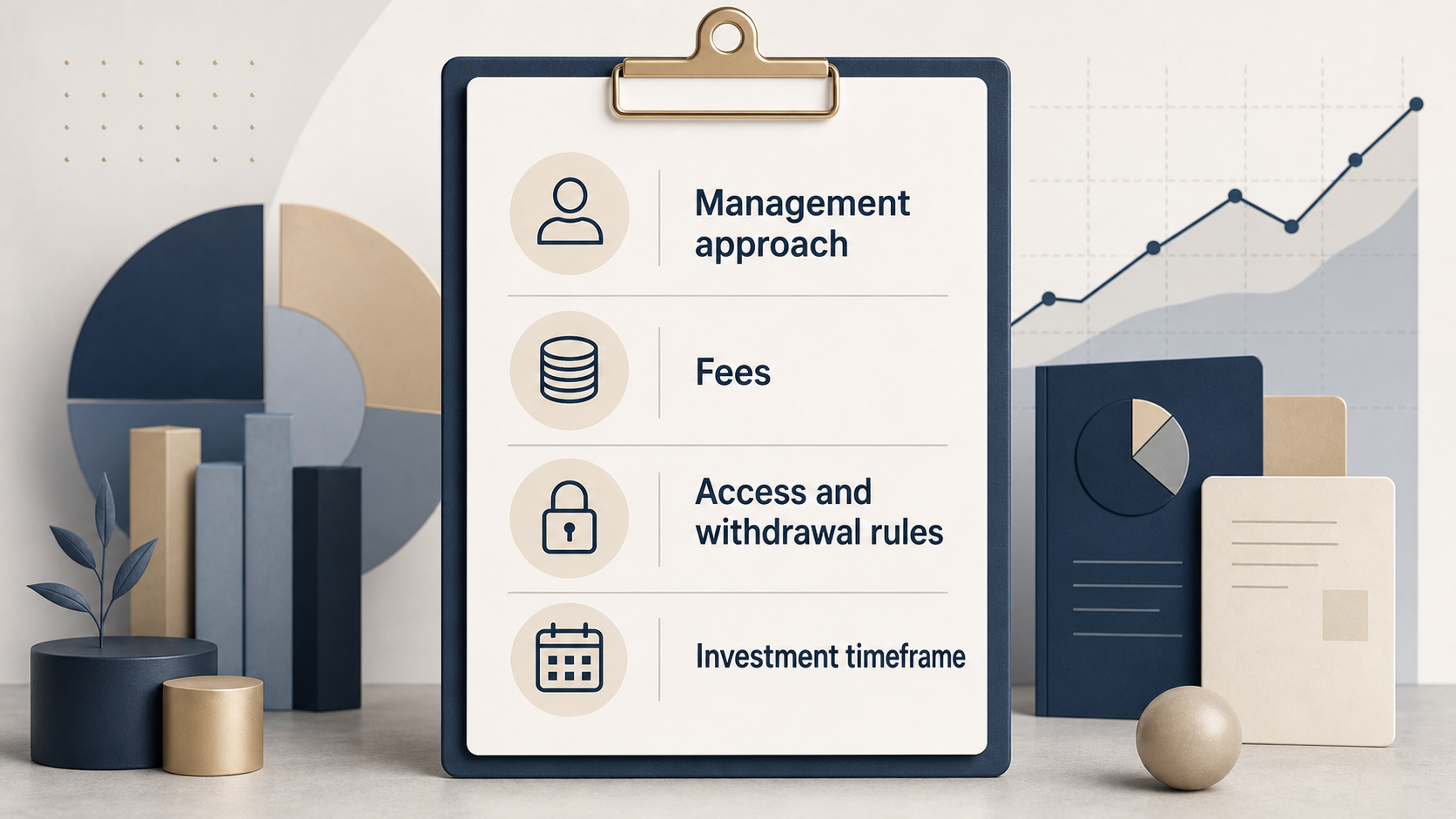 Compare alternatives when you are unsure whether you need managed investing at all, want to select your own investments, or are choosing between account wrappers and access terms. A useful comparison is criteria-led rather than brand-led.
First, compare the management approach. Ask whether the provider manages and rebalances a portfolio for you, as J.P. Morgan Personal Investing does, or whether you choose and manage holdings yourself. Next, compare total charges: separate platform or management fees from fund costs, transaction charges and spreads, and use each provider’s current documents rather than an advertised headline alone.
Then check account availability and access. Confirm whether the account you need is offered, what withdrawal restrictions apply, and how an ISA withdrawal affects allowances. Investment choice and support also matter: a managed service may offer defined styles, while a self-directed platform may provide a broader selection but require more decisions from you.
For newer investors, independent beginner-platform coverage can help identify the types of questions worth asking, including timeframe and emergency savings. It should not be used as proof of J.P. Morgan features or as a substitute for current product documentation. Before acting, compare official terms, charges and risk disclosures for each provider and ensure the service matches your own needs.
Frequently Asked Questions
Is there a minimum investment or lock-in period?
J.P. Morgan Personal Investing says there is no minimum investment period and clients are not locked in. However, it says the service is designed for long-term investors and suggests considering a timeframe of at least three years. Particular account types may have their own withdrawal restrictions.
How easy is it to withdraw money from J.P. Morgan Personal Investing?
The provider says clients can withdraw whenever they like and that it does not charge for withdrawals. That general statement has important exceptions: Junior ISAs, Lifetime ISAs and Personal Pensions have withdrawal restrictions. For ISAs, a withdrawal does not restore the part of the annual allowance already used.
What fees does J.P. Morgan Personal Investing charge?
It charges an annual management fee for discretionary management, with published rates varying by investment style and value tier. The provider also identifies investment fund charges and market spreads, and says set-up and transaction charges for buying and selling investments are reflected in portfolio performance. Check the current fee schedule and dashboard breakdown for the portfolio under consideration.
Is J.P. Morgan Personal Investing suitable for beginners?
It may be worth assessing for a beginner who prefers managed portfolios and understands that capital is at risk. Suitability depends on personal objectives, timeframe, risk tolerance, charges and account rules. This is general information, not a personal recommendation.
[Explore digital investing platforms and managed portfolios before making a decision.]
Sources
Related reading
- Best digital investment platforms in the UK: an evidence-led comparison of fees, accounts and service models
- J.P. Morgan Personal Investing vs Moneyfarm: fees, portfolios, accounts and support compared
- Moneyfarm review: who the platform may suit and where its limits matter
- Managed vs DIY investment platforms: how control, cost and responsibility differ
Editorial information: About our editorial team · Read our editorial policy · Read our affiliate disclosure.