Managed and DIY investment platforms can both provide a way to invest online, but they divide the work differently. A managed service typically uses information about your goals and risk appetite to place you in a portfolio, while a DIY service leaves the selection of investments with you. The useful comparison is therefore not simply “which is better?”, but who makes the decisions, who maintains them and which charges apply.
This is general information for UK readers, not personal financial, tax or legal advice. Provider terms, account availability and charges can change, so confirm the current details before acting.
Managed and DIY investment platforms at a glance
A managed digital investment service is designed to take on more of the portfolio-building process. MoneyWeek describes robo-advisers as online platforms that use an investor’s goals and risk appetite to tailor a portfolio, commonly after an online questionnaire. The service may then allocate the investor to one of several portfolios with different levels of risk and potential return.
DIY investing puts the investor in charge of choosing what the portfolio holds. Moneyfarm’s DIY service, for example, describes the proposition as building a portfolio that is uniquely yours, with platform guidance and market insights available alongside it. That is a useful distinction: help, research and an easy-to-use platform do not necessarily mean the provider has assumed responsibility for choosing every holding.
Neither label answers every practical question. “Managed” can cover a service with a defined range of portfolios, while “DIY” can cover different investment ranges, tools and dealing arrangements. Start by identifying the decision you want to delegate: choosing investments, keeping allocations in line with a plan, or neither.
Portfolio construction: delegated selection or investor choice
In a managed model, the starting point is usually a set of questions about objectives, timeframe, intended investment amount and attitude to risk. According to MoneyWeek’s overview of robo-advisers, that information can be used to assign an investor to a portfolio with a particular risk and return profile. The investor still has an important role in supplying accurate information and checking that the service’s published approach is understood.
With a DIY platform, the central choice is more direct: the investor decides which investments to buy and how much of the portfolio each should represent. Moneyfarm presents its DIY option as a way to build a personalised portfolio, supported by expert guidance and market insights. The platform may provide tools or information, but the investor should check the terms to establish exactly which decisions remain theirs.
Control is therefore not just the ability to press “buy”. It includes setting an allocation, deciding whether to diversify across holdings, and changing that allocation when circumstances or views change. A managed service can reduce the number of implementation decisions; a DIY service can give more latitude over holdings. In either case, investing involves risk and outcomes are not guaranteed.
Ongoing monitoring and rebalancing
The responsibility split continues after the initial investment. MoneyWeek notes that robo-advisers can remove some of the work involved in choosing funds and keeping an eye on a portfolio. That can make a managed model relevant to people who want a provider-led process for ongoing portfolio maintenance rather than a fully self-directed approach.
Automation is not the same as eliminating investment risk. A portfolio can still fall in value, and an investor still needs to understand the service they hold, its stated risk level and any account-specific rules. Review how a provider describes its monitoring, portfolio changes and the circumstances in which the investor must make a choice themselves.
For a DIY portfolio, the investor generally needs to decide how often to review holdings and whether the mix has moved away from the allocation they intended. Rebalancing may involve selling part of one holding and buying another, which can bring dealing costs, spreads or tax considerations depending on the account and the investments. The appropriate schedule is not universal; the first task is to establish what the platform automates and what it leaves to the account holder.
Fees: platform charges, management fees and investment costs
AI-generated generic editorial illustration — not a retailer product photo and does not depict the reviewed product or service. Give readers a visual framework for comparing published charges without presenting a universal cheapest-platform claim.
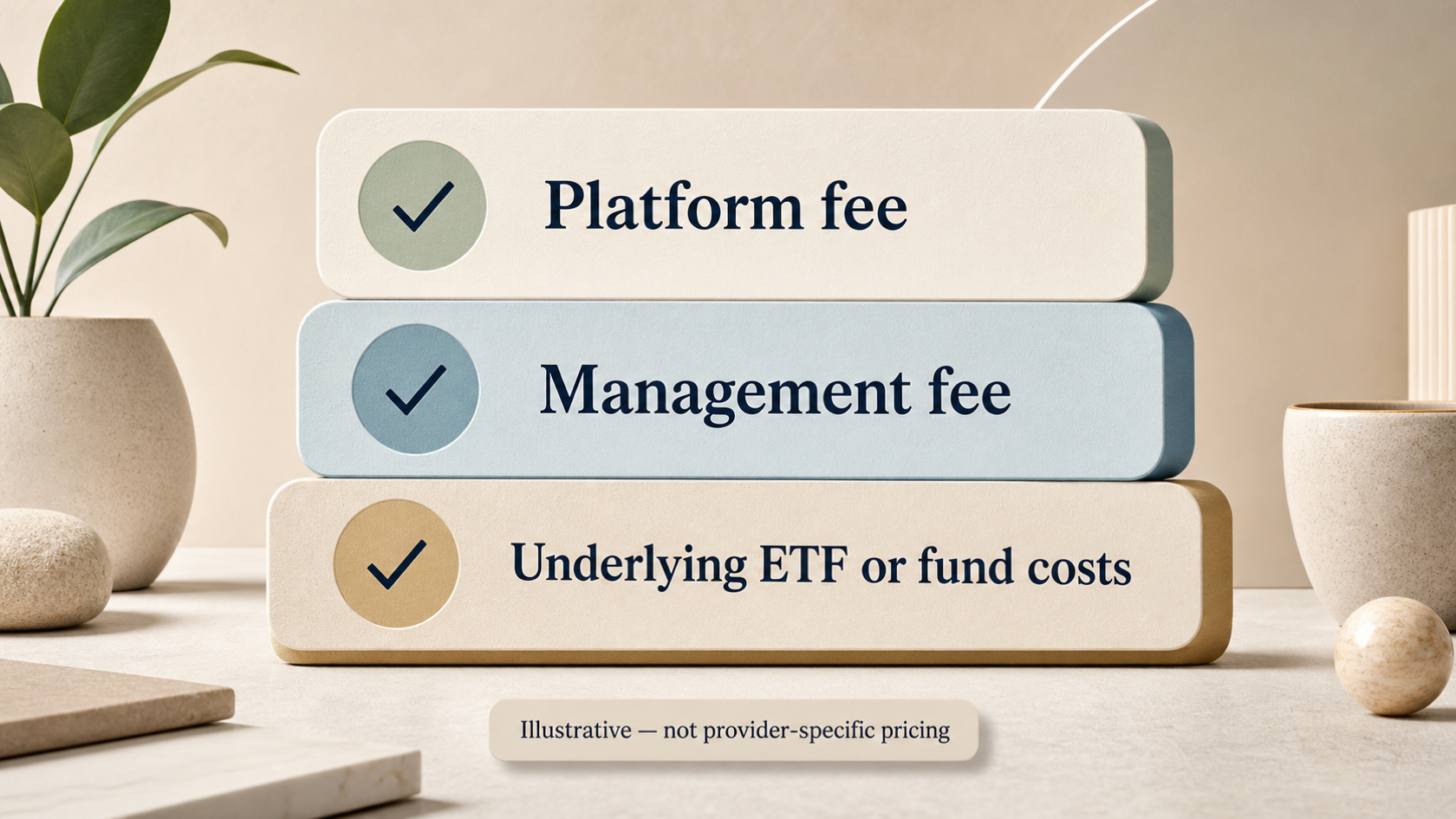 Compare charges in layers rather than relying on one headline number. The first layer is the platform or account charge. The second is any management charge for a managed service. The third is the cost of the investments themselves, such as ETF charges; dealing costs, market spreads and foreign-exchange charges may also matter depending on the service and transactions.
InvestEngine’s published costs page illustrates why those layers should remain separate. It states that its account fees are zero for its ISA, General Account, Personal Pension (SIPP) and Business Account. It also lists a zero InvestEngine fee for its DIY option, while its Managed option carries a 0.25% annual InvestEngine fee. The same page says ETF costs and market spread apply to both portfolio routes.
That example is not a universal pricing rule or a ranking of platforms. A zero platform fee does not mean investing is cost-free if the selected ETFs, funds, spreads or transactions have their own costs. Conversely, a stated management fee should be checked for what it includes rather than compared in isolation.
Before comparing providers, list each charge in the same order: account or platform fee, management fee where applicable, investment-level cost, and transaction-related cost. Moneyfarm says it aims to present its pricing transparently and without hidden fees, but readers should still use each provider’s current pricing page and account terms for a like-for-like comparison.
Account types, investment range and service limits
 A platform can be attractive in principle but unsuitable for the account wrapper or service model you need. InvestEngine’s costs page lists ISA, General Account, Personal Pension (SIPP) and Business Account options, and says that portfolios sit inside accounts. It presents DIY and Managed as separate portfolio choices: the former lets customers choose their own investments, while the latter is described as letting InvestEngine’s experts help.
This shows why account availability and portfolio choice should be checked separately. The presence of an ISA does not by itself establish that every investment, management option or feature is available within that ISA. Likewise, an account offered by one platform does not establish that another platform offers the same account, minimum, investment range or dealing functionality.
Make a short eligibility and access check before focusing on fees: which account is required, whether the relevant service is available in it, what investments can be held, whether transfers are supported, and whether any minimum or transaction rules apply. Use the provider’s current account pages and terms for those details rather than assuming that an option advertised elsewhere in its range will apply to your chosen account.
A practical comparison checklist
Use a consistent sequence when comparing managed and DIY platforms:
- Define the decision boundary. Decide whether you want to choose individual investments yourself or use a portfolio selected from information about your goals and risk appetite.
- Check the ongoing task. Read how the provider describes monitoring, portfolio adjustments and investor actions. A managed process may reduce routine work, but it does not remove investment risk.
- Compare all cost layers. Separate account fees, management fees, underlying investment costs, dealing charges, spreads and any FX costs that could apply.
- Check the account and service combination. Confirm that the ISA, General Account, pension or other wrapper you need is offered with the specific DIY or managed service you are considering.
- Read the current terms before making a decision. Published fees and features can change, and provider information should be checked at the time of use.
The evidence here supports a general comparison framework, not a personal recommendation. If a decision depends on your individual circumstances, confirm the provider’s service terms and consider whether you need personalised regulated advice rather than general platform information.
Frequently Asked Questions
Is a managed investment platform the same as receiving financial advice?
Not necessarily. The supplied evidence describes digital wealth managers or robo-advisers as a middle ground between using a financial adviser and taking a DIY approach. They may use an online questionnaire about goals and risk appetite to allocate an investor to a portfolio, but that does not establish that every managed platform provides personalised financial advice. Check the provider’s terms to understand the nature and limits of its service.
Are DIY investment platforms always cheaper than managed platforms?
No universal conclusion follows from the service labels. InvestEngine’s published example shows a zero provider fee for its DIY option and a 0.25% annual provider fee for its Managed option, while ETF costs and market spread still apply. Other platforms can have different account charges, management fees, investment costs and transaction charges. Compare the complete cost structure for the exact account and service you would use.
Who is responsible for rebalancing a DIY portfolio?
The investor should establish this from the platform’s service description. A DIY model centres on the investor choosing the portfolio’s investments, so the investor should not assume that the provider will make allocation changes on their behalf. Review the platform’s tools and terms, then decide how the portfolio will be monitored and whether any rebalancing activity could create costs or other consequences.
Can I use an ISA with either a managed or DIY investment platform?
It depends on the provider and its current service range. InvestEngine lists an ISA and presents both DIY and Managed portfolio options, but that is evidence about InvestEngine’s published offering rather than every UK platform. Confirm that your chosen provider offers the required ISA and that the intended managed or DIY service is available within it before opening or transferring an account.
Sources
Related reading
- Best digital investment platforms in the UK: an evidence-led comparison of fees, accounts and service models
- J.P. Morgan Personal Investing review: strengths, limits, fees and alternatives
- InvestEngine review: DIY, managed portfolios, fees and trade-offs
- How to choose a managed investment platform: fees, risk, account wrappers and support
Editorial information: About our editorial team · Read our editorial policy · Read our affiliate disclosure.