Digital investment platforms do not have one universal winner. The useful comparison is between the level of control you want, the account you need and the complete set of charges you may pay. Investing carries risk, and charges, account availability and tax treatment can change.
Our verdict: match the platform to the level of investment control you want
 The most defensible starting point is not to pick a single “best” provider. First decide whether you want to choose investments yourself, delegate portfolio construction, or combine the two. A DIY service gives you more control over ETF selection, while a managed service generally takes responsibility for building and maintaining a portfolio within the risk level you select.
InvestEngine illustrates the distinction clearly: its DIY option lets customers choose investments, while its Managed option puts portfolio management in the hands of its experts. Its published pricing also differs by route: DIY has no InvestEngine fee, whereas Managed has a 0.25% annual InvestEngine fee; ETF costs and market spread can still apply to both.
That does not make either route right for everyone. Before applying, confirm current charges, account eligibility and product documentation directly with the provider. This is general information, not personal investment, tax or legal advice. Your capital is at risk.
What counts as a digital investment platform?
A digital investment platform is an online service used to hold and manage investments. The main models in this comparison are managed digital wealth services and execution-only, or DIY, investing.
A robo-adviser or digital wealth manager sits between traditional financial advice and doing everything yourself. It commonly asks about your goals, investment timeframe and attitude to risk, then allocates you to a portfolio with a chosen risk level. This can reduce the day-to-day work of choosing and monitoring individual funds, but it is not automatically the same as receiving personalised regulated financial advice.
A DIY account is different. You select the investments and take responsibility for the portfolio decisions. That can suit someone who wants to choose ETFs directly and understands the risks involved, but it also means deciding how to diversify, rebalance and respond to market movements.
Some providers span both models. InvestEngine says customers can either choose their own investments or use managed portfolios. That flexibility may be useful, but it still requires a careful comparison of the accounts, charges and service limits attached to the option you choose.
Compare the full cost, not just the platform fee
AI-generated generic editorial illustration — not a retailer product photo and does not depict the reviewed product or service. Help readers assess the complete cost stack rather than comparing a headline platform fee alone.
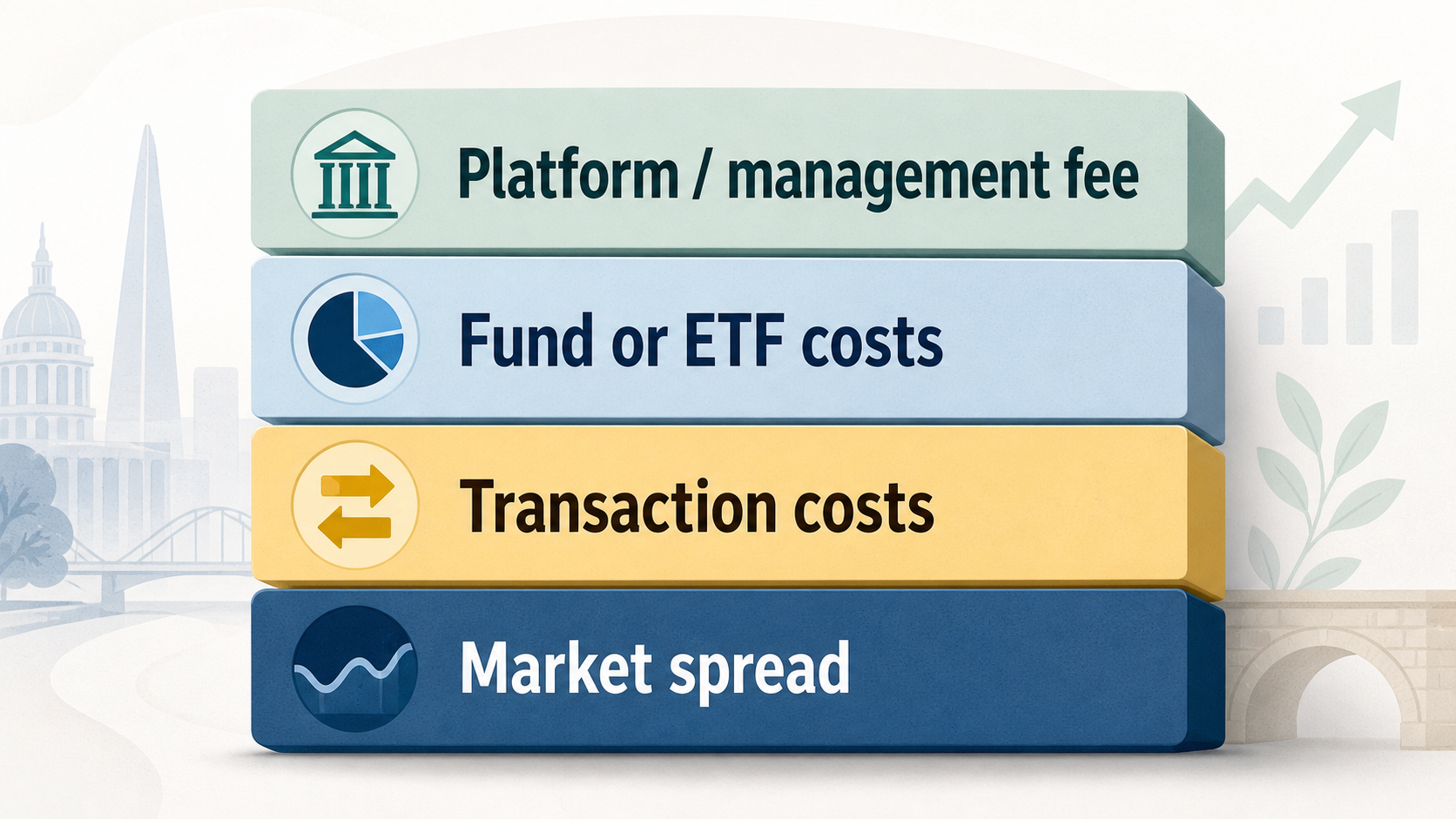 A headline platform fee is only one part of the cost picture. Compare the full stack: platform or management fees, underlying fund or ETF costs, transaction costs where applicable, and the market spread paid through investment pricing. A lower-looking account fee does not necessarily mean a lower total cost.
Wealthify publishes approximate fund and trading fees of 0.14% a year for Original Plans and 0.46% a year for Ethical Plans. It says these figures vary and are charged as part of the investment arrangement, so they should be considered alongside its own plan fee rather than in isolation. Wealthify also says it does not charge for deposits, withdrawals, transfers or closing a plan; that does not remove investment costs or market risk.
InvestEngine states that it charges no account fee on its listed accounts. For its portfolios, it says DIY investors pay no InvestEngine fee, while Managed investors pay a 0.25% annual InvestEngine fee. In both cases, ETF costs and market spread apply. This is a practical example of why “zero account fee” is not the same as “zero cost”.
J.P. Morgan Personal Investing explicitly separates management fees, investment-fund charges and market spread. It says management fees depend on the value of the pot and investment style, while fund and spread costs are reflected in the investments. Moneyfarm describes its pricing as simple and transparent, but the supplied information does not provide a full numerical schedule. Check each provider’s current detailed fee page before comparing them side by side.
Account types, minimums and service limits can change the answer
The account can be as important as the fee. A Stocks and Shares ISA, a personal pension or SIPP, and a general investment account have different purposes, eligibility rules and tax treatment. A platform that looks attractive on price may not offer the account or transfer arrangement you need.
InvestEngine lists ISA, General Account, Personal Pension (SIPP) and Business Account options, each with a stated zero account fee. It also offers both DIY and managed portfolios inside its accounts. That does not establish whether another provider has identical account availability, transfer terms or investment controls.
The available material does not give complete, like-for-like detail for all named providers on minimum deposits, transfer treatment, withdrawals, fund universe, execution features or eligibility. Treat any missing field as “verify with provider”, not as a favourable or unfavourable assumption. Confirm the current minimum funding, transfer rules, available investments and product restrictions before opening or moving an account.
UK digital investment platforms: the evidence-led comparison
| Platform | Documented service model | Documented charge information | Account and limit check |
|---|---|---|---|
| Wealthify | Managed investment plans | Approximate fund and trading fees: 0.14% p.a. for Original Plans and 0.46% p.a. for Ethical Plans; provider says fees vary. | Verify current plan fee, accounts, minimums and investment limits with provider. |
| Moneyfarm | Managed-service example | Says pricing is simple and transparent; supplied material has no detailed figures. | Verify current fee schedule, account types, minimums and transfer terms with provider. |
| J.P. Morgan Personal Investing | Managed-service example | Separates management fee, fund charges and market spread; management fee depends on pot value and investment style. | Verify current rates, accounts, minimums and service restrictions with provider. |
| InvestEngine | DIY and Managed | No account fee stated; DIY: no InvestEngine fee; Managed: 0.25% annual InvestEngine fee; ETF costs and market spread apply. | Lists ISA, General Account, Personal Pension (SIPP) and Business Account; verify eligibility and current terms. |
This table is deliberately not a ranking. Wealthify provides published underlying-cost estimates in the supplied material, while Moneyfarm’s excerpt does not contain a comparable numerical schedule. J.P. Morgan explains its charge categories but the supplied excerpt does not provide a like-for-like rate table. InvestEngine provides a clear DIY-versus-managed fee distinction, but that does not settle suitability, investment choice or total costs for every reader.
Shortlist by investor preference, not by a single best-platform label
Start with the service model that matches your preference.
- Managed-first: consider a managed portfolio if you want portfolio construction and ongoing management to be delegated. Compare management fees, underlying investment costs, account availability and the risk approach before deciding.
- DIY-first: consider a DIY ETF route if you want to choose investments yourself and accept responsibility for those decisions. Check the available ETF range, trading features, ETF charges and market spread.
- Mixed-control: a provider offering both routes may be worth investigating if you want to compare self-directed investing with a managed alternative in the same broader platform.
If you need a personal recommendation, tax planning or an assessment of whether an investment is suitable for your circumstances, use a regulated financial adviser rather than treating a platform comparison as advice.
Alternatives if a digital platform is not the right fit
A digital investment platform is not the only route. Someone who needs personalised planning, help with complex tax questions or a suitability assessment may be better served by regulated financial advice. Someone who cannot accept investment losses, or who needs the money over a short timeframe, may need to consider whether a cash-saving product better matches their objective instead.
No platform comparison can predict returns or determine personal suitability. Before applying, check the provider’s current pricing, account eligibility, minimum deposits, transfer and withdrawal rules, risk disclosures and product documents. Keep in mind that tax treatment depends on individual circumstances and may change.
Frequently Asked Questions
Are robo-advisers cheaper than using a financial adviser?
They can have a different cost structure, but the supplied evidence does not support a universal price comparison. Robo-advisers typically automate portfolio allocation after collecting information about risk, goals and timeframe. Compare the full charge stack and the level of service you need; a lower fee is not automatically a replacement for personalised advice.
What is the difference between a managed portfolio and a DIY investment account?
With a managed portfolio, the provider builds and manages the portfolio according to its process and the risk level selected. With a DIY account, you choose the investments yourself. InvestEngine describes these as distinct routes: DIY lets customers choose investments, while Managed uses its experts. The trade-off is control versus delegated portfolio management.
Can a zero account fee still mean I pay investment costs?
Yes. InvestEngine says it has no account fee, but also states that ETF costs and market spread apply. J.P. Morgan Personal Investing similarly describes separate management, fund and market-spread charges. Always check the charges beyond the account fee.
Should I choose a Stocks and Shares ISA or a pension account?
That depends on your objectives, eligibility, access needs and tax circumstances. InvestEngine lists both ISA and Personal Pension (SIPP) accounts, but a platform comparison cannot determine which is suitable for you. Read the current account terms and seek regulated advice if you need a personal recommendation.
Sources
Related reading
- J.P. Morgan Personal Investing vs Moneyfarm: fees, portfolios, accounts and support compared
- J.P. Morgan Personal Investing review: strengths, limits, fees and alternatives
- How to choose a managed investment platform: fees, risk, account wrappers and support
- How to compare investment platform fees: management, fund, spread and transfer costs
Editorial information: About our editorial team · Read our editorial policy · Read our affiliate disclosure.